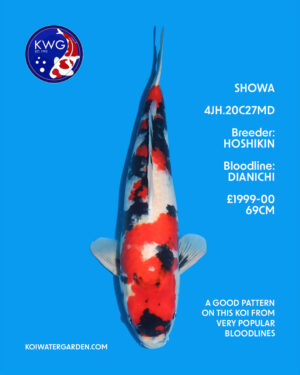
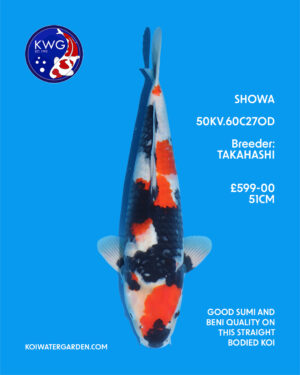
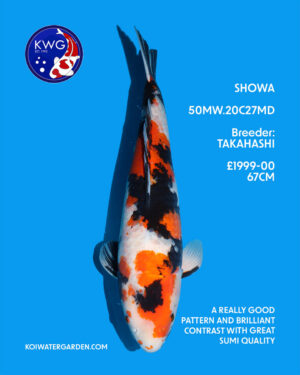
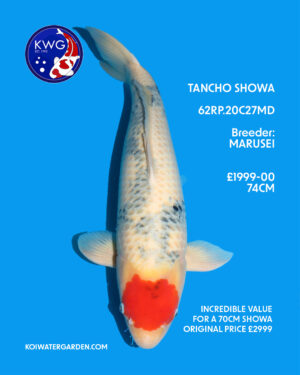
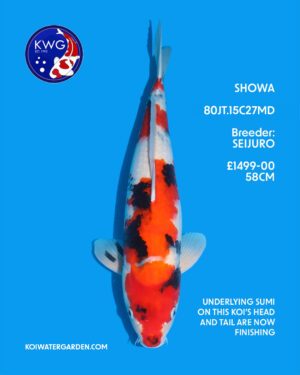
Showa
Showa are a striking variety of Koi, and a member of the ‘big three’ main Go Sanke group.
Showa are a black based Koi and also display Shiroji (White) and Beni (Red).
Bloodlines of Showa have been vastly improved by many breeders throughout Japan, making jumbo proportions achievable whilst maintaining high quality traits.
Showa have also gone on to win the Grand Champion award at the prestigious All Japan Show – which has only ever been achieved by the main three Go Sanke varieties.
History and Development
The Showa koi originated in Japan during the 1920s and was named after the Showa era. Early breeders aimed to create a koi with a solid black foundation and contrasting red and white patterns. Through selective breeding, the modern Showa evolved into a refined and highly sought-after variety.
Unlike the Kohaku or Sanke, which have a white base, the Showa is distinguished by its black foundation. This gives it a dramatic appearance and makes it a favourite in koi shows, where judges assess the balance and harmony of its three colours.
Sumi on Showa can take between 5 – 6 years to fully develop, but subtle changes can also occur for many years after, making this variety and excellent one to learn from as changes early on in their life can be quite dramatic.
Characteristics of Showa
Showa are admired for their bold appearance and intricate patterns. Key features include:
1. Sumi (Black Base): The black base should be deep and glossy, providing a strong contrast to the red and white markings. Sumi on a Showa is generally more consolidated with a deep wrapping type appearance that often falls below the lateral line – unlike that of a Sanke where the sumi tends to sit above the lateral line.
2. Beni (Red Markings): The red patterns are vivid and well-defined, often covering significant portions of the body. The quality of the red plays a crucial role in the overall beauty of the Showa.
3. Shiroji (White Markings): The white areas should be clean and bright, adding balance and elegance to the koi’s appearance.
4. Pattern Balance: A good example of a Showa displays a harmonious distribution of all three colours, with the sumi often appearing on the head and extending across the body. Showa don’t necessarily have to display an even amount of the three colours – Kindai (modern) style Showa are currently popular where a sparse Beni pattern is present but displaying more white ground as opposed to a heavy Red and black pattern of the more traditional style.
5. Head Markings: The head is a critical area for judging a Showa. Ideally, all three colours—black, red, and white—should be present, creating a balanced and eye-catching pattern. Menware – or Hachiware is a sumi pattern that splits across the head and is also very desirable.